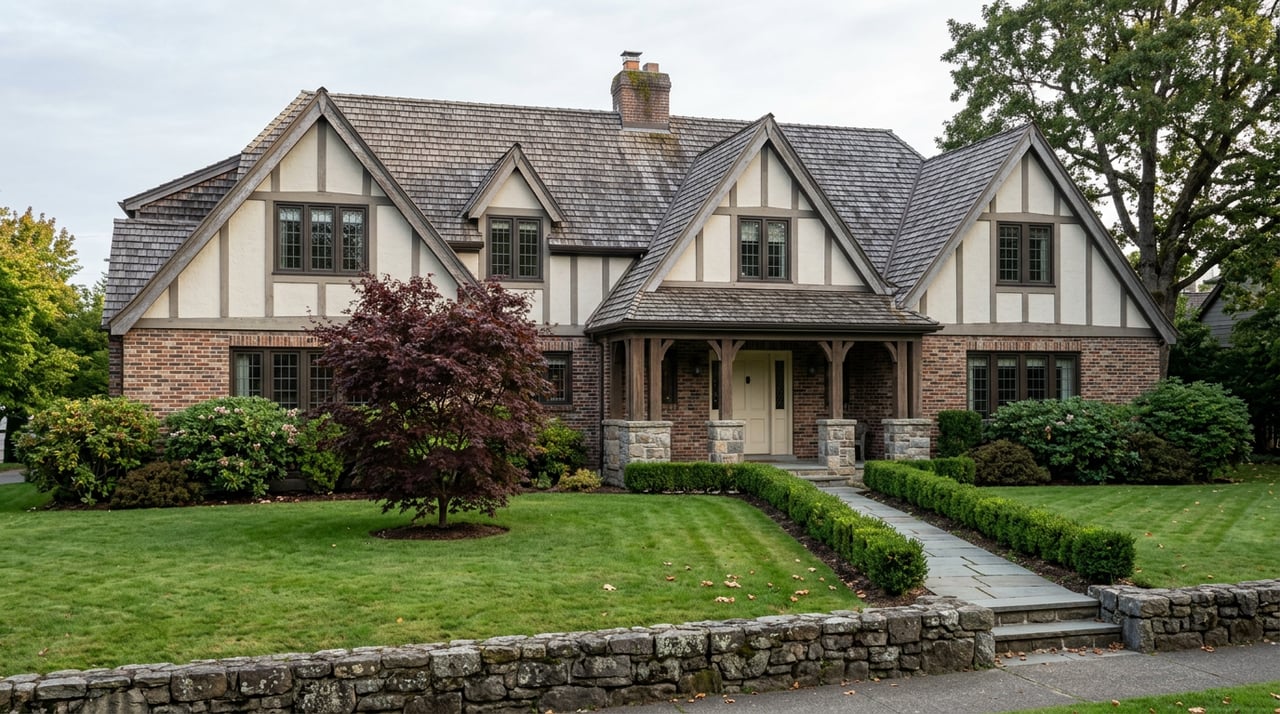
In Stevens, the Zoning Line Runs Down the Middle of the Neighborhood
September 24, 2026
September 24, 2026
Two Stevens listings hit the market this spring within three weeks of each other. Both were 1910s craftsmans, similar square footage, similar lot size, priced within $40,000 of each other. Neither listing mentioned that one of them sits inside a zoning tier that allows six housing units by right, and the other tops out at four. Nothing in the disclosure paperwork flags it. Nothing in the listing photos hints at it. The difference is a matter of a few hundred feet, and it changes what each lot is actually worth to a buyer thinking past move-in day.
That gap exists because Seattle's zoning code changed under nearly every single-family block in the city this year, and Stevens, sitting east of 15th Ave E between Volunteer Park and Madison Valley, happens to straddle one of the sharper versions of that new line.
On December 16, 2025, the Seattle City Council adopted Council Bill 120993, formally Ordinance 127376, which replaced interim zoning rules with a permanent update to the city's Neighborhood Residential code. It took effect January 21, 2026. The legislation exists because Washington's 2023 middle housing law, House Bill 1110, required cities over 75,000 people, Seattle among them, to allow a wider range of housing types on land that had been reserved for one house per lot. Neighborhood Residential zoning covers roughly two-thirds of the city's residential land, and Stevens' interior blocks fall squarely inside it.
The baseline the new code sets is simple: every Neighborhood Residential lot in Seattle now allows at least four dwelling units by right. No conditional use permit, no rezone application, no public hearing. A duplex, triplex, fourplex, or stacked flat is now a permitted use on land that a year ago allowed exactly one house.
Four units is the floor, though. It is not the ceiling everywhere.
The same ordinance raises that ceiling to six units on any lot that sits within a quarter mile of what the state law calls a major transit stop, or where at least two of the units are set aside as affordable housing. A quarter mile is roughly a five-minute walk at a normal pace, which is a much tighter radius than most people assume when they hear "near the station."
The state's definition of a major transit stop is not limited to light rail. It also captures bus corridors that run frequently enough on weekdays, generally averaging service every 15 minutes or better through the middle of the day. That detail matters in Stevens specifically, because the neighborhood sits between two different kinds of frequent transit rather than just one.
Capitol Hill Station, at 140 Broadway E, anchors the western edge of the neighborhood right along 15th Ave E and Broadway. Local descriptions of the walk from deeper in Stevens to that station run 10 to 15 minutes, which puts a meaningful share of the neighborhood's interior blocks outside the quarter-mile bonus radius even though the station feels close. The blocks that actually fall inside that ring tend to be the narrow strip nearest 15th and Broadway, not the quieter streets toward Volunteer Park or Interlaken Park.
Then there's Madison Street, running along Stevens' southern edge toward Madison Valley, where the RapidRide G Line operates. If that corridor meets the state's frequency threshold at a given stop, it draws its own separate quarter-mile ring, independent of the light rail station. A lot that misses the Capitol Hill Station radius by two blocks could still land inside a Madison Street radius, or miss both.
None of this is something a listing sheet is going to spell out. It is something a buyer, or a seller pricing a lot for its full redevelopment potential, has to check parcel by parcel using Seattle's own GIS tools before assuming either four or six units applies.
| Baseline tier (4 units) | Bonus tier (6 units) | |
|---|---|---|
| Trigger | Standard Neighborhood Residential lot | Within ¼ mile of a major transit stop, or 2+ affordable units on site |
| Unit types allowed | Duplex, triplex, fourplex, stacked flats | Same types, plus fiveplex and sixplex configurations |
| Parking required | No | No |
| Design review | Streamlined under the new code | Streamlined under the new code |
| ADU stacking | Still applies on top (see below) | Still applies on top (see below) |
The practical distance between these two tiers is not cosmetic. A lot that can only reach four units supports a much smaller redevelopment footprint, and a much smaller pool of builders willing to take it on, than one that can legally reach six. That difference shows up in what a developer or an owner-builder is willing to pay for the land underneath an aging craftsman, independent of the house itself.
Separate from the unit-count tiers above, a different set of rules already lets any single-family lot in Seattle, regardless of which zoning tier it lands in, add up to two accessory dwelling units on top of the primary house. One can be attached, inside or connected to the existing structure. One can be detached, a backyard cottage sized up to 1,000 square feet for a one or two-bedroom unit, or 1,200 square feet for three or more bedrooms, with height allowed up to 32 feet in most Neighborhood Residential zones. Neither requires added off-street parking. Neither requires the owner to live on the property.
Those rules came from a related but distinct piece of legislation, Ordinance 127211, adopted to comply with House Bill 1337, and they took effect in mid-2025, ahead of the broader middle housing update. They apply on any qualifying lot in the city, four-unit tier or six.
What that means in Stevens is that even a lot capped at the four-unit baseline can, in practice, carry a main house plus two additional dwellings once ADUs are counted toward the total. A single-family listing that reads like one household on a quiet block can already function, or be converted to function, as three separate units without touching the middle housing rules at all.
Stevens carries an above-average share of pre-1930 architecture for a Seattle neighborhood, including the preserved mansions on 14th Ave N known locally as Millionaire's Row, a block that survived earlier waves of teardown development largely intact. That kind of housing stock creates a different complication than the zoning map does.
Some of Seattle's wealthiest enclaves, Broadmoor among them, are shielded from the new middle housing rules entirely because they operate under homeowner association covenants that predate the state law and that HB 1110 explicitly does not override. Stevens has no such blanket carve-out. It is ordinary city-jurisdiction land, subject to whatever zoning tier applies to each parcel.
But individual buildings, not entire districts, can be nominated for landmark status at any time in Seattle, and that nomination process can pause or significantly complicate redevelopment on that specific lot regardless of what the zoning code otherwise allows. Housing advocates have flagged this as a live tension elsewhere in the city, where opponents of new middle housing construction have pursued landmark nominations on individual eligible properties as a way to slow projects down. Stevens' concentration of well-preserved, decades-old homes makes it exactly the kind of neighborhood where that tool is more likely to surface on a given parcel than it would on a block of 1980s construction.
The practical upshot: a lot's zoning tier tells a buyer what is legally possible. Whether the specific house on that lot carries landmark exposure is a separate question, worth asking before treating any redevelopment number as settled.
Two Stevens homes at the same price no longer compare the way they used to on beds, baths, and lot square footage alone. The questions that actually separate them now include how far the parcel sits from a qualifying transit stop, whether that distance clears a quarter mile from Capitol Hill Station or from a Madison Street RapidRide stop, whether the existing structure could carry ADUs on top of whatever the base zoning allows, and whether the specific building has any landmark exposure given its age. None of that shows up in a standard listing description, and a median price for the neighborhood averages all of it away.
Does this mean my Stevens home is about to become a sixplex? No. The zoning update opens the option; it does not require redevelopment on any timeline. Most existing homes will stay exactly as they are unless an owner chooses otherwise.
How do I find out which tier a specific address falls into? Seattle's Department of Construction and Inspections maintains parcel-level zoning lookup tools, and the city's ADUniverse platform lets you check ADU feasibility on a given lot directly. Confirming a specific address is a better move than assuming based on the neighborhood name.
Do ADUs count toward the four or six-unit cap? Yes. An accessory dwelling unit counts as a unit under the new code, which is part of why a four-unit baseline lot can end up functioning closer to what the six-unit tier allows once ADUs are added.
If you're weighing a purchase in Stevens, or trying to price a lot you already own for what it can actually become, this is exactly the kind of parcel-specific groundwork worth doing before an offer goes in. James Campbell works Seattle and Eastside transactions where the zoning fine print matters as much as the square footage. Let's Connect.
Stay up to date on the latest real estate trends.

Real estate, for me, is about obsessive and detailed customer service. Customer service is not just a strength of mine, it is my professional and personal North star. Whether you’re looking for your first, next, or moving from your current home, I look forward to helping you on your home buying or selling journey.